Why do Some International Businesses Fail?
Lessons from Companies That Couldn’t Conquer Foreign Markets.
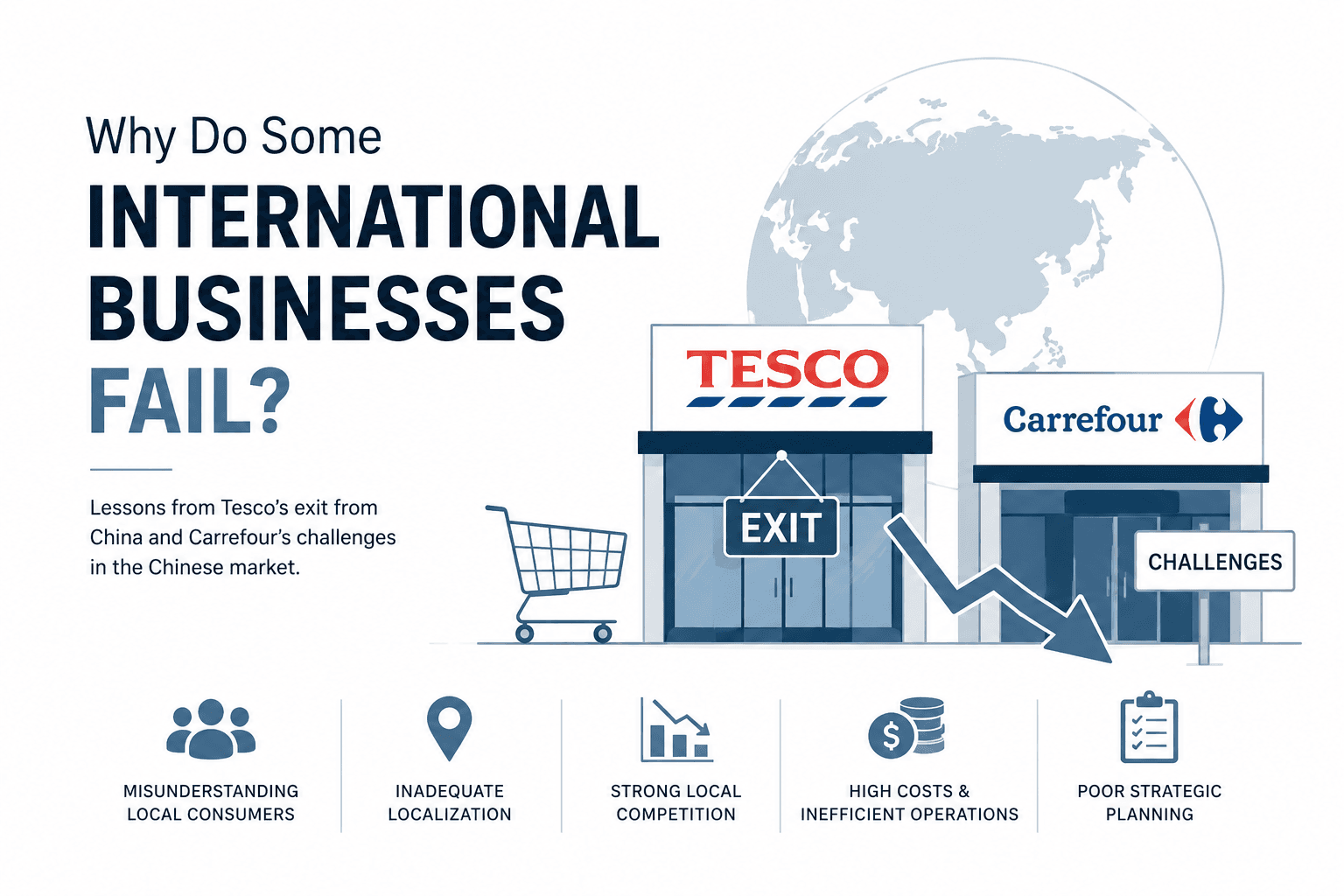
When a successful company performs well in its home country then it’s naturally considered that it'll be successful in other countries. But in international business, success simply cannot be transferred from one country to another. Every foreign market has its own consumers, culture, competition, regulations and purchasing habits. Due to this, many famous companies of the world faced unexpected failures after international expansion. The Fresh & Easy experiment of Tesco in the United States and the struggle of Carrefour in China are the interesting examples of this scenario. These cases show that global expansion is not all about launching a successful business model to another country but understanding local market and adapting strategy accordingly is also necessary.
Tesco: From UK to United States
Tesco was a major supermarket company of UK who launched its own grocery business launch by the name of Fresh & Easy in United States in 2007. Before entering the US market, the company did thorough research before entering US market and tried to understand the preferences and tastes of US consumers. However, business did not get expected success on practical level. Tesco established stores in California, Arizona and Nevada and expanded around 200 stores in few years. But business could not be profitable and Tesco decided to exit US markets in 2013. According to reports, the total cost of this expansion for Tesco reached around €2 billion.
US entry → rapid store expansion → high costs → insufficient profitability → exit
Why did Tesco actually fail?
Tesco case shows that simply researching market is not sufficient for successful international expansion. Fresh Easy had to face strong competition in United States where established Businesses like Walmart, Costco, Whole Foods and Trader Joe's were already serving consumers. The store location and business format of Tesco had also faced criticism. And some stores were in such neighbourhood where target customer fit was not strong. Reports further highlighted that Fresh & Easy was neither a discount model nor a premium model in its positioning. Which made the identity weaker in heavy competition. Apart from these, housing crisis and US recession also affected consumer spending in 2007.
Carrefour China: Different market, different problem
Carrefour, a major retail company of France, entered in China in 1995. Initially, company used localization strategies in Chinese market and adjusted their offerings according to consumers’ needs in different regions. However, over time Chinese retail market changed rapidly. Local competitors, e-commerce platforms and changing consumer shopping habits increased the competition for traditional hypermarket. Till 2018, Carrefour China sales were near €3.6 billion but company sold it's 80% stake to Suning.com on €1.5 billion enterprise value. Carrefour’s CEO considered small market share and digital competition in China, in important challenges.
Tesco → market positioning + competition + expansion strategy
Carrefour → changing retail environment + local competition + e-commerce + digital transformation
What can Global Businesses learn?
The comparison of these two cases clearly shows the "one strategy fit all" approach in international business isn't effective. A company can be successful in its home market but in foreign countries it must understand different consumer behaviour, culture, local competition, pricing, regulations, technology and distribution systems. I'm case of Tesco, rapid expansion and weak market fit are important lessons to be considered. Whereas Carrefour experience shows even a company who's trying to adapt in local market, it must continuously evolve with changing technology and domestic competitors. Therefore, a successful global expansion doesn't mean "entering a foreign market" but "understanding, adapting and continuously responding to that market."
- Lessons
- Failures
- Global Business