Understanding Korean Chaebols Businesses.
The Power of Chaebols: How Family-Owned Korean Companies Shaped South Korea’s Global Economy.
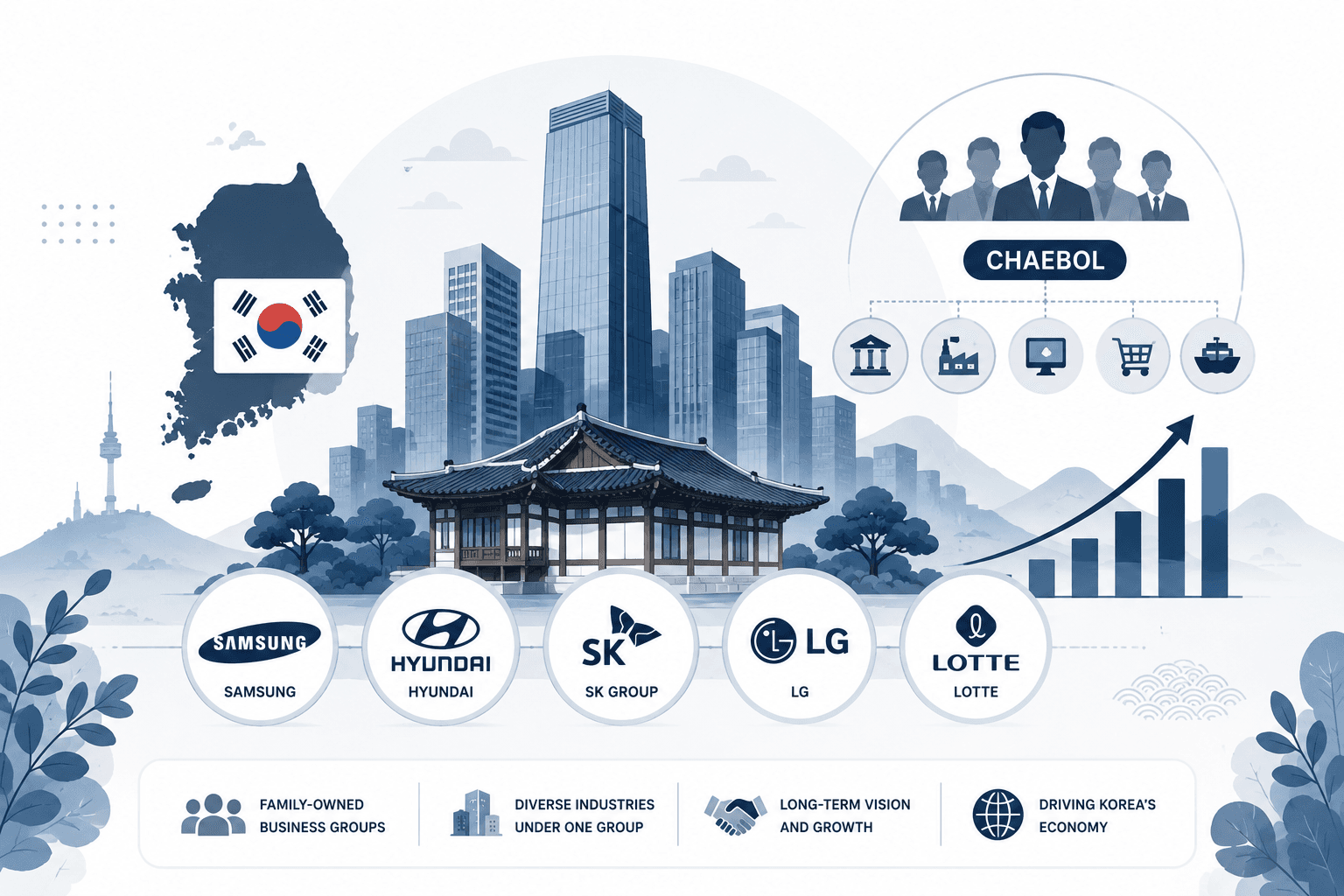
Chaebols have played an important role in economic development South Korea. Chaebols are large, family-controlled business groups in South Korea. A single family often has strong control over these business groups, which combines multiple companies operating in different industries. These companies may have separate legal entities, but they are closely connected through ownership, management and business relationships. The family’s control is often maintained through cross-shareholding, ownership structures and leadership succession. The Korean government strongly supported these large business groups, especially from the 1960s to 1980s through loans, incentives and industrial policies which contributed to rapid economic growth.
Major Chaebols and Their Different Sectors
Samsung: Electronics, semiconductors, construction, financial services etc.
Hyundai: Automobiles, construction, engineering etc.
SK Group: Energy, chemicals, telecommunication etc.
LG Group: Electronics, chemicals, batteries etc.
In the 1960s, the main focus of the South Korean government was on rapid industrialization and export-led growth. Therefore, the government strongly supported chaebols. According to the World Bank and IMF, some of the main reasons for supporting chaebols were:
South Korea had small domestic markets with limited natural resources. Therefore, the government relied on large firms to target global export markets.
The government needed large-scale production. It believed that large firms could rapidly develop industries by achieving economies of scale.
To increase exports rapidly, exporters were offered low-interest credit, tax benefits and other incentives.
To develop heavy industries, the Korean government promoted strategic sectors such as steel, shipbuilding, petrochemicals, automobiles, electronics and construction in the1970s.
This support allowed chaebols to grow into large-scale companies capable of helping Korean products compete in international markets.
International Business Role:
Chaebols played a central role in the international business growth of South Korea especially after the 1960s. Chaebols accelerated export growth. In the 1960s, Korean exports accounted for around 3% of GDP. This increased to 14% in 1970s and 33% in 1980s. According to IMF, Chaebols played a key role in this strong export performance. Large groups like Samsung and Hyundai gradually entered international markets through sectors such as automobiles, electronics, ships and chemicals. The large size of chaebols helped achieve economies of scale and operate large industrial projects. Export competition provided strong incentives for chaebols to improve technology and develop in-house R&D capabilities. In the 1990s, large Korean firms moved from low and middle-technology manufacturing toward High-tech exports. In the 2000s, they expanded production overseas and developed into genuinely global companies.
Benefits:
The chaebol model had several benefits including rapid industrialization. Large chaebols had the capacity to undertake large-scale projects. This helped Korea to rapidly develop industries such as steel, shipbuilding, petrochemicals, automobiles and electronics.
Chaebols specialized in export-oriented manufacturing and international competition pushed them to improve their technology. Chaebols could achieve economies of scale due to their large size. This meant they could reduce costs by producing goods on a large scale. International competition provided chaebols with incentives for investing in innovation and technology.
Problems/ Challenges:
However, the chaebol model also had several challenges including the concentration of economic power. Chaebols became so large that their dominance increased significantly across Korea’s industrial sector. Chaebol’s rapid expansion was often financed through borrowed money. Before 1997, their debt levels became high, increasing their vulnerability during financial crises.
Some chaebols aggressively expanded into multiple industries and made investments that failed to generate adequate returns. The IMF identified problems such as excess capacity, low profitability and excessive diversification. The close relationship between the government and chaebols sometimes raised concerns about preferential treatment, political business collusion and excessive risk-taking.
- Korean chaebols
- Problems
- Benefits