Hyundai Motors: A Case Study of Global Growth
Explore Hyundai’s journey from a Korean automaker to a globally recognized automotive brand.
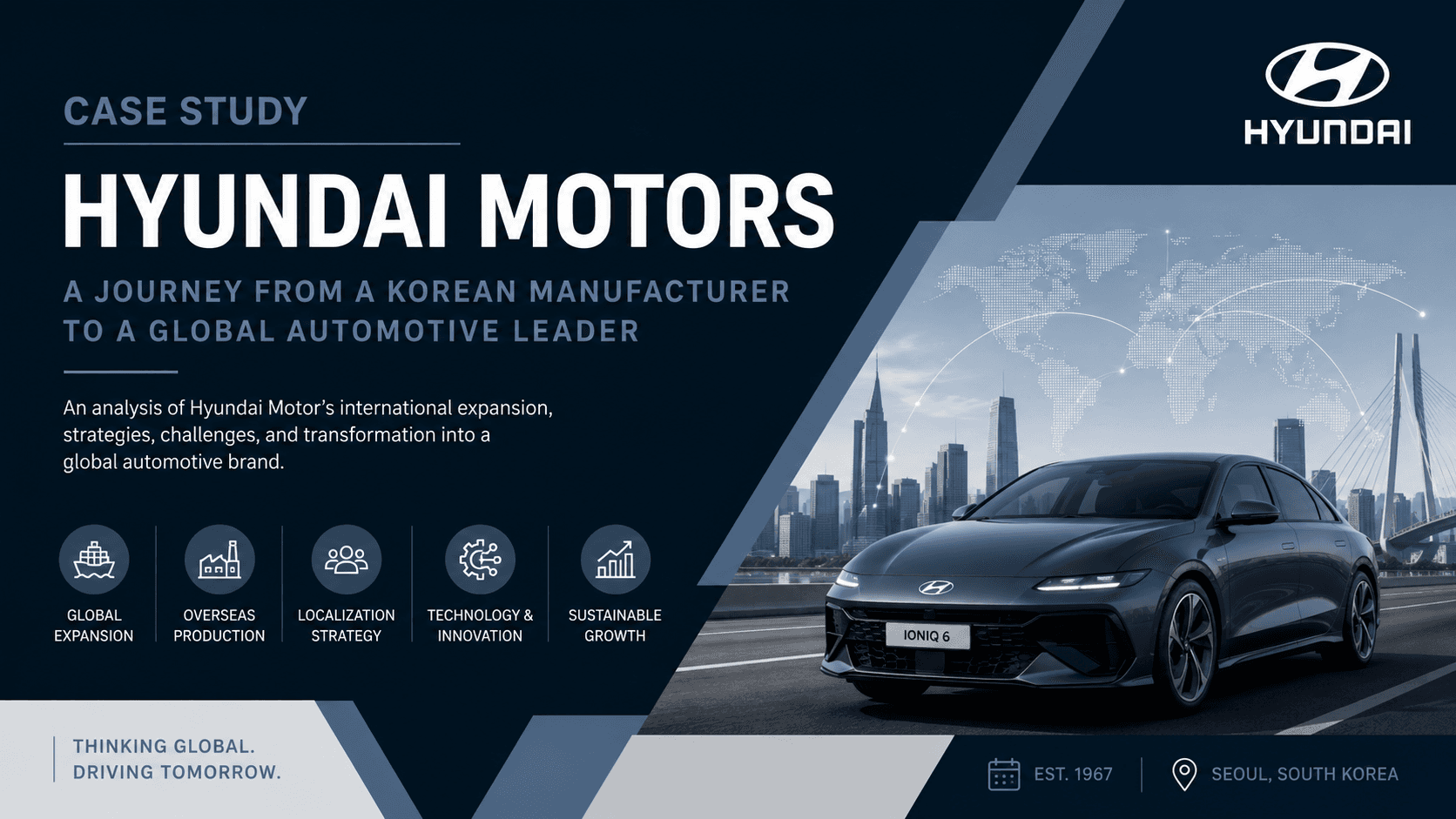
Introduction and History of Hyundai Motors:
Hyundai is a multinational company in South Korea, based on manufacturing cars and other vehicles. The company is counted as one of the biggest automobile companies in the world. After the Korean war in 1950-1953, South Korea became one of the poorest countries in the world. The founder (Chung Ju-Yung) of Hyundai played a central role in rebuilding the nation. Chung Ju-Yung founded Hyundai Motors in 1967. its headquarters are located in Seoul, South Korea. Before Hyundai Motor, the Company entered the automobile industry, Chung Ju-Yung’s broader Hyundai Group had played an important role in South Korea’s infrastructure development, including the construction of roads, bridges and other major projects. The rapid economic transformation of South Korea during this period became widely known as the "Miracle of Han River". In 1975, the company launched a "Pony" car. Pony was the first mass-produced passenger car of South Korea and became the pride of the nation. Hyundai's development remained closely connected to the broader industrialization of South Korea. Gradually, the company moved from domestic markets to international markets and eventually became a global automotive brand. In 1976, Hyundai Ecuador exported Pony which became an important starting point of international expansion. Afterwards, Hyundai entered major markets like Canada and the United States. In 1986, Hyundai debuted the Excel in the US market, where it achieved strong sales and became the best-selling import compact car for three years in a row. Excel achieved a leading position in the US imported compact car.
Hyundai Group is an important part of the history, economy and culture of South Korea. The significance of this company in South Korea can be determined by the fact that it is considered the fate changing of the nation. In South Korea, large family-owned business groups are usually referred to as “chaebols,” and Hyundai Motor Group is among the major business groups in the country. As per the assessment in 2025, Hyundai Motor Group has contributed an estimated 359.4 trillion won (around $264.6 billion) to the economy in 2024, which is the largest contribution of any South Korean conglomerate listed in the study. A big part of the total exports of Korea, depends on the vehicles of Hyundai and Kia Motors. Moreover, Hyundai Motor Group has been able to form an extensive ecosystem of jobs and suppliers in South Korea through its subsidiaries and partner organizations. The Company did not remain dependent on exports only but also developed its technology and engineering capabilities. In 1991, Hyundai Motors developed an Alpha engine, which was a crucial step towards technological independence for the company. In this period, Hyundai expanded its research and development capabilities, which strengthened the foundation of future products and international competitiveness.
Today, the scale of Hyundai's global expansion is very much significant. In 2025, the company sold around 4,138,389 vehicles worldwide, in which 3,425,435 vehicles were sold outside South Korea. This implies that about 83% of the total sales made by Hyundai Motor was generated outside South Korea. According to Hyundai’s recent corporate information, the corporation operates in over 200 nations globally. In 2025, the company earned revenue around KRW 186.3 trillion, whereas electrified vehicle sales reached approximately 961,812 units. The transformation of Hyundai Motor is particularly important because the company did not let its international competitiveness depend on low-cost manufacturing only. Over time, the company increased its investment in quality, technology, design, R&D, overseas production and brand building. This gradual transformation helped Hyundai become a globally recognized automotive brand from a Korean automobile manufacturer.
INTERNATIONAL EXPANSION OF HYUNDAI MOTORS:
The international expansion strategy of Hyundai was not something that happened overnight; the company began with exports, gradually developed overseas production facilities, and eventually built a global manufacturing network. To understand this journey, the period from 1976 to 2000s is particularly important. Hyundai entered an international market for the first time in 1976 by exporting the Pony to Ecuador. It was the first foreign export of Hyundai and became the beginning point of the company's global expansion. After this, Hyundai expanded into Canada in 1983 and began exporting the Excel to the United States in 1986. The strong initial sales of Excel in the US gave visibility to Hyundai in the North American market.
Hyundai's model was relatively simple in the Initial stage. The cars were manufactured in Korea and exported to foreign markets. As Hyundai’s international presence expanded, local production offered advantages in reducing transportation costs, improving market access and responding more effectively to local customer requirements. Therefore, Hyundai initiated its transition from exports to overseas manufacturing. A major milestone in this transition was marked by the formation of Hyundai Assan in Turkey. This joint venture was formed by Hyundai Motor Company and Kibar Group in 1995, while the production started in 1997. According to Hyundai's official history, it was the first major overseas production base of Hyundai outside Korea. In Turkey, Hyundai entered through a partnership. Hyundai Assan project was developed after the agreement between Hyundai Motor Company and Kibar Holding, and mass production began in 1997.
After Turkey, Hyundai established its plant in India in 1998. The India facility became Hyundai’s first integrated automobile manufacturing plant outside South Korea. This plant provided the opportunity of locally manufacturing for the Indian Market alongside the regional export base of Hyundai. Then Hyundai began to aggressively expand overseas production. In 2005, production started in the United States, whereas in 2006, a plant was established in the Czech Republic. The establishment of production facilities across China, India, Turkey, the United States and Europe gradually became the foundation of Hyundai’s global production and management system.
A significant part of this strategy is that Hyundai no longer depends solely on exporting cars produced in South Korea to other countries. Alongside overseas plants, the company increasingly localized production, sales, marketing, R&D and customer services to meet the needs of individual markets. In Hyundai's US operations example, the company localized product development, design, production, sales, marketing and customer service. Hyundai also used strategic partnerships to enter and develop different markets. The partnership with Kibar Group in Turkey is one example, while in China, production was developed through the Beijing Hyundai joint venture. This approach helped Hyundai to obtain local knowledge, distribution networks and market access.
Hyundai's internationalization can be understood by simple progression:
South Korea
↓
1976 — Pony export to Ecuador
↓
1983 — Canada / 1986 — United States exports
↓
1997 — First major overseas production plant in Turkey
↓
1998 — India manufacturing plant
↓
2002 — Beijing Hyundai begins production in China
↓
2005 — United States production
↓
2006 — Production begins at the Czech Republic plant, followed by further expansion in Europe and other regions.
↓
Global manufacturing + global brand
BUILDING A GLOBAL BRAND
Hyundai’s international expansion was not limited to selling cars in other countries. The company gradually improved its quality, technology, design and brand image. Initially, Hyundai's cars were seen as affordable vehicles, but the company improved its reputation by investing in research and development, better engineering and product quality. The development of the Alpha engine in 1991 was an important milestone for Hyundai because it strengthened the company's technological capabilities. With time, Hyundai gradually built an association between its vehicles, quality and technology.
Furthermore, to become successful in global markets, Hyundai also focused on branding and marketing. The company improved its brand recognition through international advertising, sports sponsorships, digital marketing and global campaigns. The purpose of this strategy was to build an image of a reliable global automobile brand in the minds of international customers. Vehicle Design remained the central part of this transformation because Hyundai designed its vehicles and models according to the changing preferences of the customers in international markets.
LOCALIZATION: THINK GLOBAL, ACT LOCAL
An important aspect of Hyundai's international business strategy was localization. The company did not use the exact same strategy in every market. Hyundai adjusted its products and business strategy after observing and understanding different customers’ incomes, preferences, road conditions, government policies and demand in different countries. India is a good example in this regard where alongside local manufacturing, Hyundai also focused on understanding the needs of Indian customers. Similarly, the company developed local production, marketing, sales and customer services. This approach helped Hyundai establish its presence in different international markets.
TECHNOLOGY AND ELECTRIFICATION
In today's advanced era, the automobile industry has been changing rapidly. Therefore, the next stage of Hyundai's international competitiveness is connected to technology and electrification. The company increased its investment in electric vehicles, hybrid vehicles and hydrogen technology. In 2025, Hyundai Motor sold 4,138,389 vehicles globally, in which 961,812 vehicles were electrified. This shows that alongside traditional petrol vehicles, the company is also focused on future automobile technologies. Investment in technology helps Hyundai remain competitive amid the changing environmental regulations and international customer preferences.
CHALLENGES AND TURNING POINTS
Throughout the international growth of Hyundai, the company had to face various significant challenges. The 1997 Asian Financial Crisis was a major economic crisis for South Korea and Korean businesses. Hyundai Group faced financial difficulties and restructuring. An important turning point of this period was Hyundai Motor’s acquisition of Kia Motors in 1998. This development helped Hyundai to expand its scale and product portfolio in the automobile industry. The combined capabilities of both companies provided a stronger foundation for future international competition.
Hyundai also faced intense competition from established international automobile companies. Global brands like Toyota, Honda, Ford and European Manufacturers already had strong customer loyalty and established market presence. The biggest challenge for Hyundai was not to compete solely on affordable prices but also reach the level of its international competitors in quality, safety, technology and design. This competition pushed the company to continuously improve its products and manufacturing capabilities
ANALYSIS: WHY DID HYUNDAI BECOME A GLOBAL BRAND?
Hyundai's successful global journey was not the result of any single factor. The company first entered foreign markets through exports, then established overseas production facilities and gradually developed its strategy according to local markets. The continuous improvement in technology, quality, R&D and branding, strengthened its competitiveness. The industrial development and strong manufacturing environment of South Korea was an important foundation for Hyundai Motor. However, the company built its global position through long term investment and international strategies. An important lesson from this journey is that successful international businesses require an understanding of foreign markets and the ability to adapt to local needs.
CONCLUSION
Hyundai Motors' international expansion began through exports and gradually expanded through overseas production, localization, technological development and global branding. The Company continuously adapted its strategies to changing international markets and moved from low-cost manufacturing to technology and brand-driven competition. Hyundai's experience shows that long term success in international markets requires the development of export capabilities, innovation, localization, human capital, technology and strong branding together.
- Hyundai Motor
- Korea
- Global Business