Economic Miracle of Korea: South Korea’s Rise as a Global Economy
How Korea Became a Developed Country – Role of International Business and Export Strategy behind Korean Economic Miracle.
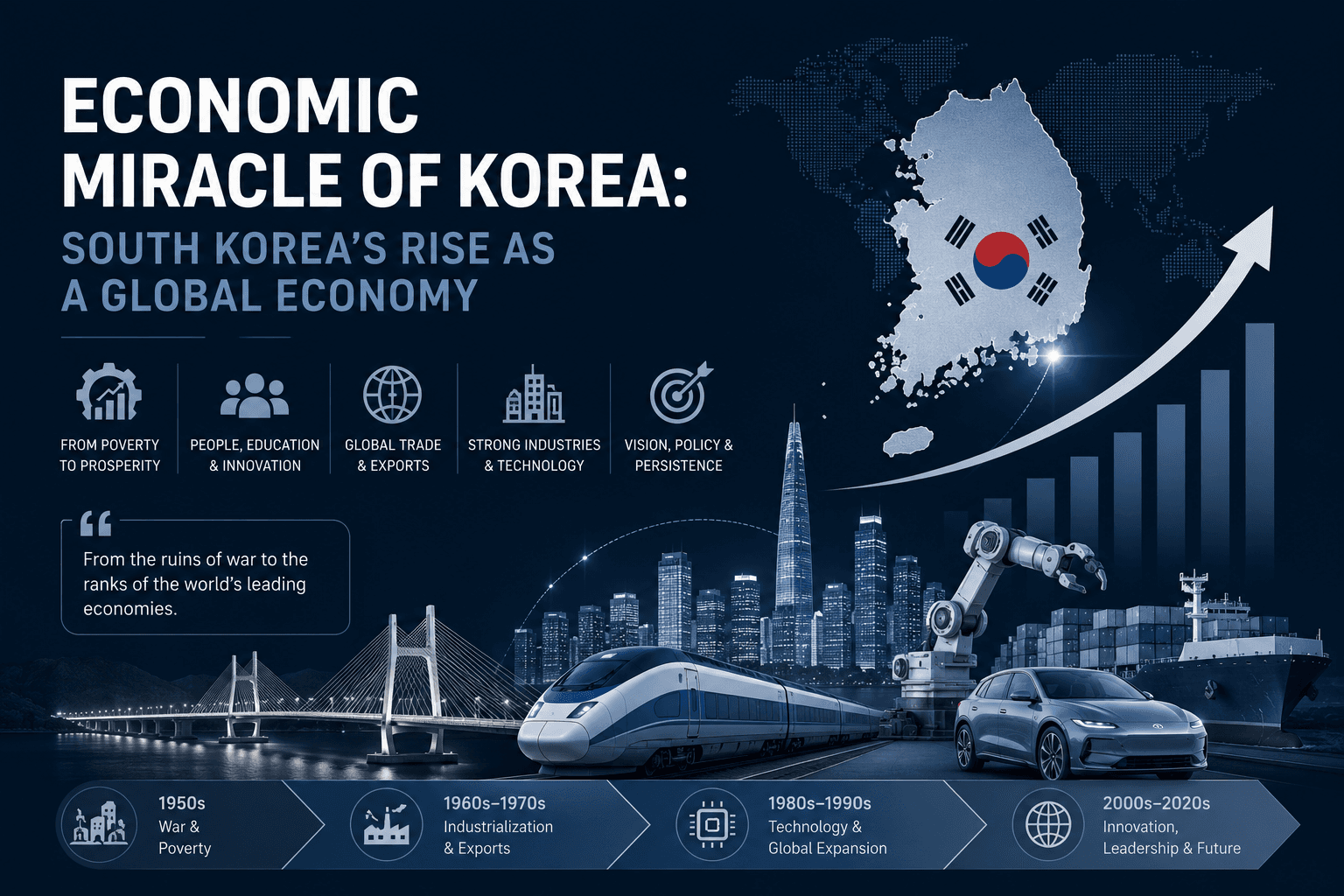
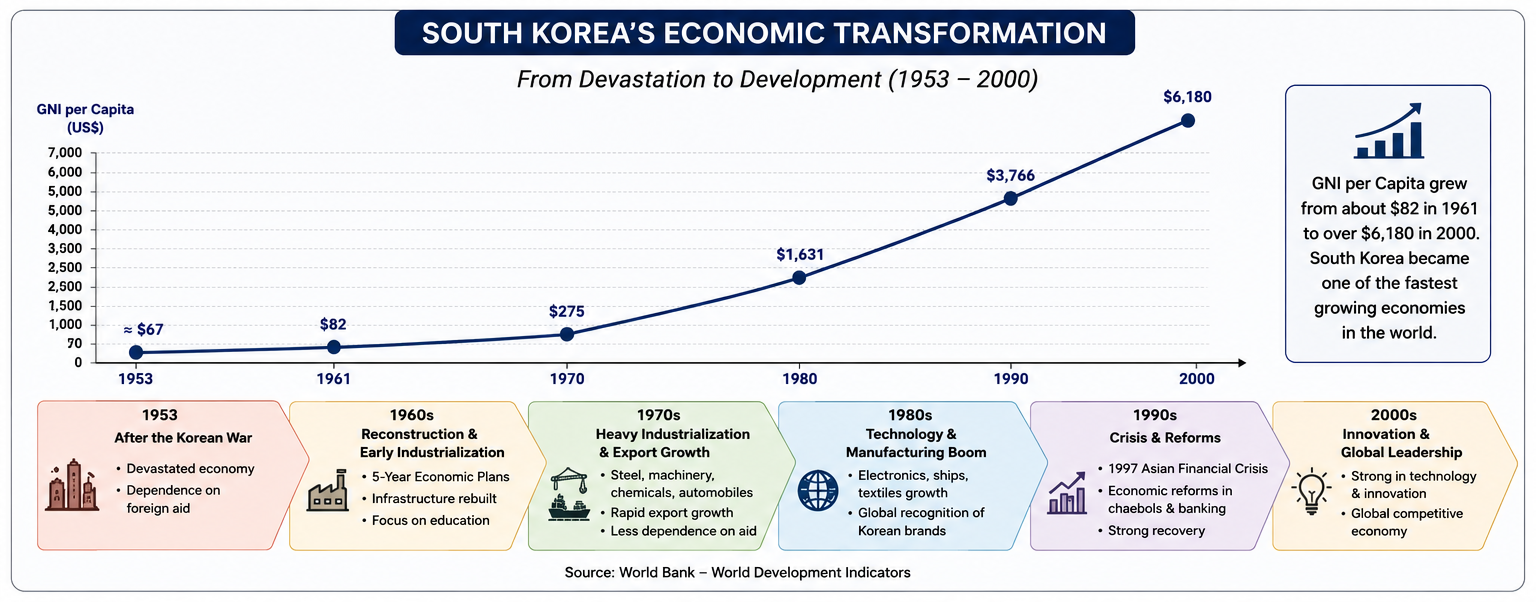
After the war ended in 1953, South Korea was devastated by the extreme poverty. The war had cost the country destructive infrastructure especially in big cities like Seoul, industries and factories had been destroyed beyond repair, Economy had collapsed badly. The war had shaken the country to its core. South Korea’s poverty can be judged by the fact that the country’s had an extremely low-level income at that time. To run the economy, South Korea was fully dependent on financial and humanitarian aids especially from the United States. By the end of 1960s, though Korea remained one of the poorest countries, it still had reconstructed the infrastructure, developed small industries and prioritized education through financial aid.
In 1961, after the military coup, Park Chung-Hee gained control as the new president. He made industrial development a national priority. He started the first five-year economic plan with the aim of doing industrialization, increasing exports, building infrastructure and providing employment opportunities. Developing infrastructure supported trade and industries. This government promoted export by encouraging the small companies to export in foreign countries. The government further supported chaebols like Samsung, Hyundai and LG by providing them with loans and tax incentives. The government also invested in technical education and trained skilled workers. In 1970s, South Korea further focused on building steel, heavy machinery and chemical automobiles industries. Now, the country was very less dependent on financial aid as South Korea had become one of the fastest growing economies in the world as the average annual income growth increased to 9% annual growth.
After 1970, South Korea began the next phase of its development. It heavily focused on increasing exports which resulted in high exports of steel, machinery, textiles, ships and electronics. Till 1980s, the economy grew stronger in the sectors of technology and manufacturing. LG and Samsung began to achieve world-wide recognition in the sector of electronics. Though the President Park was assassinated in 1979, the 80s decade remained the era of growth in technology. In 1990s, Korea continued its journey towards economy growth however in 1997 due to ASIAN Financial Crisis, Korea was also affected badly. Heavy debt incurred on many companies and some companies went bankrupt. The value of Korean currency fell below, and unemployment increased to a certain point. However, from 1988-1999 Government did economic reforms in chaebol and banking sectors. In 2000, Technology and innovation fields became stronger. These economic development years are specifically called “Miracle on the Han River”. Throughout these years, South Korea have become the 13th largest economy in the world and 4th largest economy in the Asia.
The extraordinary journey of Korean economic development doesn't only rely on government policies and industrial development, but International Business has also played an important role in Korea’s development. To improve its economy, Korea prioritized targeting foreign markets rather than staying limited to domestic markets. Through large exports, Korea earned foreign exchange, expanded the industries and improved the manufacturing sector. The competition in foreign markets made the Korean companies stronger. If Korean companies like Samsung, Hyundai and LG continued producing for domestic markets and never decided to enter foreign markets, they could never become globally competitive. The competition in international markets encouraged Korea to bring innovation, technology and quality into its production. Korea’s success is a result of the combination of government support, education, technology, and international trade. Trade reduced the barriers between countries and helped Korea develop stronger connections with other countries and become more globalized.
- Growth
- Emerging Markets